
Find what your project status is not showing.
Your team already has the data. Veridia builds the project picture for you, surfacing blockers, readiness and risk across the systems you already run, before they become delays.
First it works on your data. Then it puts the answers in one place.
Veridia connects and checks the data behind your project status, then turns it into visibility your team can actually use.
Cleans the picture
Finds the high-impact data issues first: wrong equipment tags, incorrect system assignments, missing test records, revision mismatches, and status that can't be backed by evidence.
Connects the picture
Brings completions, engineering, planning, procurement and documents into one reconciled view, giving your team a full picture of the what is happening inside your project.
-
Blockers, surfaced
What's blocked, why it's blocked, which milestone or handover it threatens, and where the evidence comes from.
-
Reporting, automated
Meeting-ready status views, weekly movement and reporting summaries generated from live project data, not rebuilt by hand every Friday.
-
Ask the data
Ask a plain-language question, “What is blocking the next handover?”, and get an answer cited back to the source system and record.
One workspace your team actually works in.
Blockers, readiness and data quality in one place, with reporting handled for you, configured around your project, so your team can see the truth, act on it, and report it with confidence.
-
See what's blocked and why
Each blocker with its reason, what it threatens, and the evidence behind it.
-
Confirm readiness is supported by data
Status verified against the tests, inspections, documents and approvals behind it.
-
Trace every finding to its source
The source system, record and document behind every finding, one click away.
-
See what changed since last week
Weekly movement, trends, and what has quietly improved or slipped.
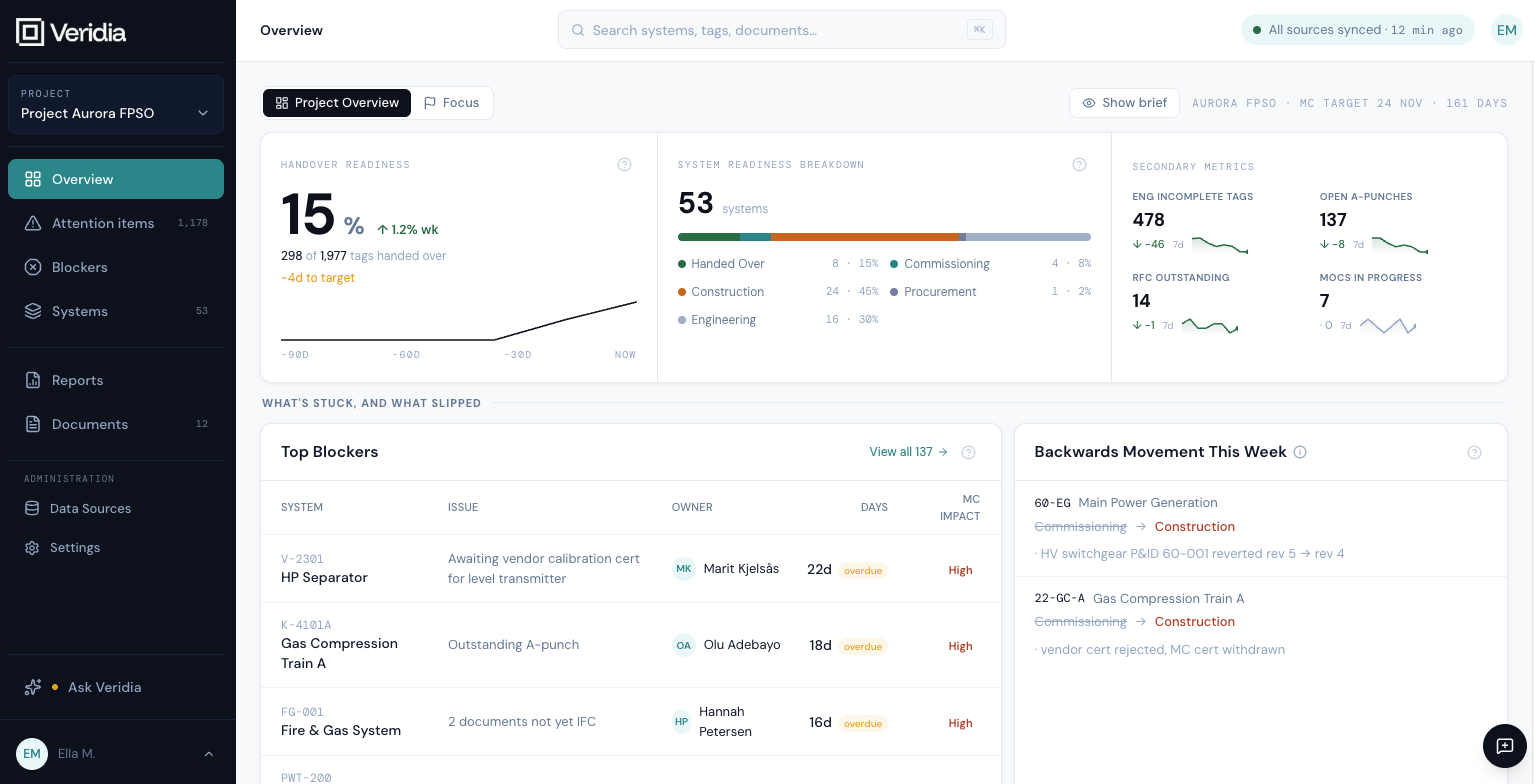
Veridia does not replace your project systems. It helps your team understand what they are already telling you.
Set up around your project, not handed over as a generic dashboard.
Veridia is configured around your reporting routines, handover gates, milestone logic and data sources, starting where the project picture is hardest to trust.
Setup starts from controlled data exports or agreed extracts, with minimal effort from your team. The result is a working Veridia workspace built around your own project data.
Six weeks · Fixed fee · Focused scope-
Week 01–02
Understand the project
Review how status is produced today, where the data lives, what the team trusts, and where the project picture breaks down.
-
Week 03–04
Configure Veridia
Structure your project data inside Veridia and configure blockers, readiness, data-quality checks, weekly movement and reporting views.
-
Week 05–06
Deliver the working workspace
Your team receives Veridia configured around the agreed scope: blockers, readiness gaps, data-quality issues and reporting views in one place.
From there: keep using Veridia, expand it to the next part of the project, or stop after the initial implementation.
Discuss implementationThe data was always there. No one had a clear view of it.
Veridia was built by a software engineer who spent years inside major oil & gas capital projects, building the tools teams relied on to see real status. It exists to close the gap that kept surfacing on every project: delays no one saw coming, sitting in plain sight across systems no single report could read.
Start with a focused part of your project.
Find what your current project status is not showing, before it becomes a delay.